
Se incarca...
Discover how AgroTrading can be used according to the specifics of your business.
AgroTrading connects validated companies, organizations and institutions within an invitation-only B2B ecosystem, built for presentation, communication and direct professional relationships.
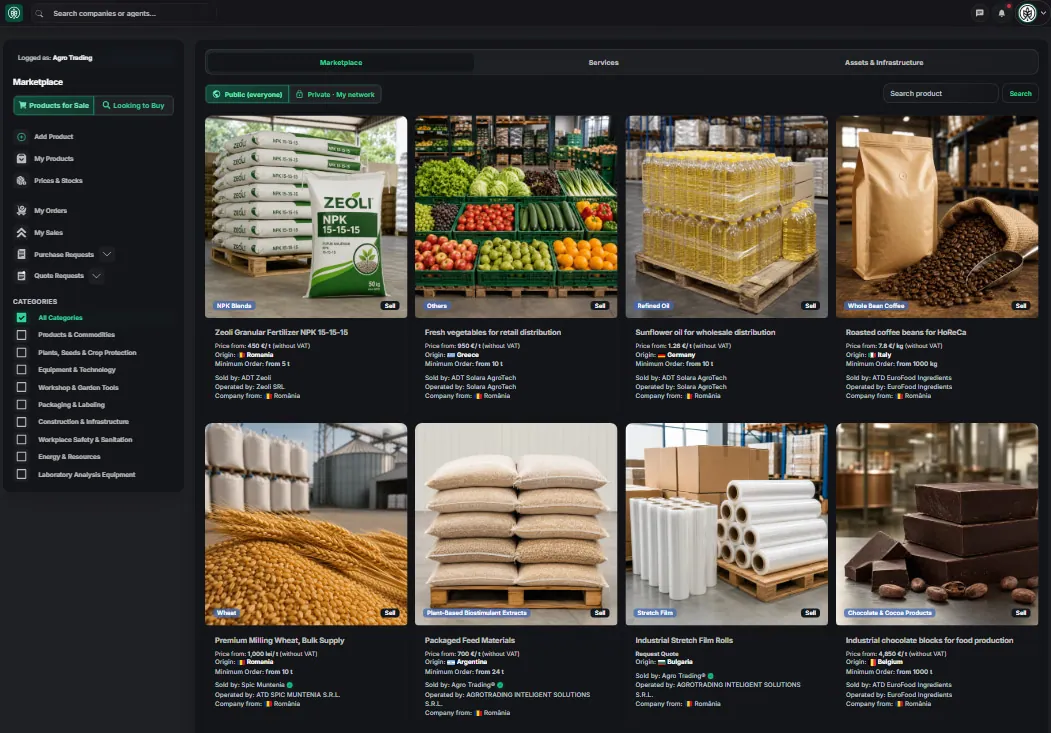
In today's economy, companies no longer operate in isolation along a single vertical, but within a chain of activity in which production, processing, storage, logistics, distribution, retail, professional services, corporate financial solutions and institutional collaboration constantly intersect. In this context, a B2B platform for the agri-food industry and related industries needs a clear structure, capable of reflecting the way companies, organizations and institutions actually collaborate in their day-to-day activity.
AgroTrading is designed as an agricultural and agri-food B2B platform, with invitation-only access, that operates as a digital ecosystem organized for validated companies, organizations and institutions. The page dedicated to industries presents how producers, processors, distributors, logistics companies, retailers, service providers, financial institutions, sales agents, independent professionals, NGOs and public institutions can find their place within the same B2B framework, in professional relationships between legal entities.
Through its structure, the platform is oriented towards direct relationships between companies, organizations and institutions that choose to communicate and collaborate in a professional environment. AgroTrading does not replace commercial contracts, legal instruments or the professional decisions of the parties. The platform offers a digital space in which B2B interactions can be presented, organized and tracked more clearly, according to the specifics of each industry and each professional relationship.
In agriculture, processing and related industries, economic activity does not take place in separate compartments. A farmer may collaborate with cooperatives, mills, bakeries, processing units, silos, transport companies and distributors. A processor may work with raw material suppliers, logistics, retail, technical services, consulting or commercial operators from other sectors. A retailer or a HoReCa operator may depend on stable relationships with producers, distributors, warehouses, service providers and other partners that are part of the same economic chain.
In the same way, many companies also need relationships with financial institutions or validated providers that communicate corporate services such as loans, leasing, factoring, guarantees, letters of credit, financial insurance or other categories relevant to B2B relationships. In today's economic ecosystems, corporate financial services and trade finance instruments are part of companies' operational infrastructure, alongside logistics, procurement, distribution and professional services.
In the absence of a shared space, these collaborations remain dispersed across general directories, separate contacts, parallel communication flows and channels that are difficult to track. A B2B platform for agriculture, the agri-food industry and related industries creates a framework in which different economic roles can be understood together, without losing the specifics of each industry. For an ecosystem such as AgroTrading, the "Industries" hub page has precisely this role: to show clearly how production, processing, logistics, distribution, retail, services, corporate financing and institutional collaboration connect to one another.
In B2B relationships, trust does not begin only from the offer or from visibility, but also from the way the environment in which professional interaction takes place is built. AgroTrading is presented as a platform with invitation-only access, within a digital ecosystem intended for validated legal entities, which supports its positioning as a space oriented towards companies, organizations and institutions that prefer a clearer framework for professional collaboration.
This model is relevant for industries in which the identity of the partner matters from the very first stage of communication. Whether it concerns producers and processors, logistics and distribution companies, service providers, retail, non-profit organizations, public institutions or financial institutions, the idea of a B2B environment organized around validated members contributes to a more coherent presentation of the ecosystem.
For users exploring the "Industries" page, this logic of access and validation conveys from the outset that AgroTrading is not built as a generic space, with listings lacking context, but as a B2B platform in which companies and organizations can present their activity within a deliberately professional framework. In an economic environment where partner verification, profile clarity and operational context have become increasingly important, this structure can matter both from a practical perspective and from that of editorial and SEO positioning.
A modern B2B ecosystem is not limited to a simple listing of products. In economic reality, companies communicate products, services, assets, infrastructure, operational capacities and, in certain contexts, corporate financial solutions relevant to their activity. AgroTrading is structured precisely to reflect this diversity of relationships in the agri-food industry and in related B2B industries.
Through its categories and pages, the platform can support the communication of agricultural products, processed goods, ingredients, food products, industrial goods, equipment, machinery, packaging, consumables and other resources used in companies' activity. At the same time, service providers can communicate professional, technical, logistical, operational or specialized services, and operators managing infrastructure can present logistics spaces, warehouses, silos, industrial facilities, commercial assets and other resources relevant to the B2B environment.
Within this logic, categories of corporate financial solutions intended for companies can also be communicated, to the extent that they are presented by financial institutions or validated providers as services relevant to B2B relationships. Loans for companies, leasing, factoring, guarantees, letters of credit, financial insurance and other instruments used in corporate activity are part of a broader ecosystem of services that support the functioning of economic chains and commercial relationships between companies.
The fact that products, services, assets, infrastructure and corporate financial solutions can be presented within the same digital framework helps users better understand how a B2B platform for agriculture, the agri-food industry, logistics and corporate services actually works. For the central "Industries" page, this structure also carries significant SEO value, because it extends the semantic relevance of the hub towards searched areas such as B2B agriculture, agri-food distribution, logistics, services for companies, trade finance, factoring or corporate banking.
An important element in AgroTrading's positioning is the emphasis placed on direct relationships between companies. In the platform's presentation, collaboration and communication take place directly between members of the ecosystem, and the commercial structure is designed with no commission on transactions, which differentiates the platform from other models in which intermediation is directly tied to the commercial value of operations.
For producers, processors, distributors, logistics operators, retailers, service providers or financial institutions, this type of architecture can be relevant precisely because it keeps the platform's role at the level of digital infrastructure and a space for organization. The platform can support visibility, the presentation of information, the structuring of categories and the interaction between legal entities, while commercial, financial or contractual terms remain established directly between the parties, outside the platform's operational role.
This approach is compatible with the way many B2B ecosystems and many modern commercial chains operate, in which the platform is not necessarily the central actor of the transaction, but the environment that makes the relationship easier to understand, communicate and manage. For the "Industries" hub page, this message carries both editorial and positioning value, because it clearly explains why different sectors can coexist within the same ecosystem without losing their operational autonomy.
AgroTrading is built within a regional context in which agriculture, agri-food processing, distribution, logistics, retail, corporate services and institutional relationships are increasingly connected at a European level. Companies no longer work only within a single market, but within extended networks in which suppliers, processors, distributors, logistics operators, commercial partners and service providers may come from different countries.
From this perspective, a hub page for the agri-food industry and related industries should not function only as internal navigation, but also as a clear explanation of how the platform can be used by companies in Romania and other European markets. The structure by industries, the neutral wording and the emphasis placed on B2B relationships between legal entities make this content easy to adapt for translation and suitable for a multilingual editorial expansion, without the need for major changes in logic or architecture.
In addition, the terminology used here, such as B2B platform, validated companies, invitation-only access, agri-food industry, related industries, products, services, assets, infrastructure, corporate financial solutions and direct relationships between companies, is clear, stable and internationalizable enough to support an SEO and GEO strategy in multiple languages. For a platform that aims to consolidate a European B2B ecosystem, this is essential both from an editorial and a technical perspective.
The central "Industries" page is not just a navigation menu, but a map of how different types of companies, organizations and institutions can find their place within the platform. Each section, from Producers and Processors, Distribution and Trading, Logistics and Transport, Retail and HoReCa, B2B Services, Financial Institutions, through to Sales Agents, Liberal Professions, NGOs and Public Institutions, shows how AgroTrading can be used according to the specifics of each activity and the role of each entity in the ecosystem.
By exploring these pages, a company can better understand its position in the economic chain, the types of relationships it can communicate within the platform and the categories of partners that may be relevant to its activity. AgroTrading brings together within a single digital framework industries that, in practice, already work together.
AgroTrading is not a party to the commercial transactions between members, does not process payments, and does not guarantee payment, delivery, product quality, service provision or the approval of any financial solutions. Any discussion, offer, documentation, analysis, negotiation or contract takes place directly between the parties involved.
Explore the dedicated pages for each industry or request an invitation to access the platform.
Today's decisions define tomorrow's collaborations.


